Today
20
in History
26
January
February
March
April
May
June
July
August
September
October
November
December
01
Sun
02
Mon
03
Tue
04
Wed
05
Thu
06
Fri
07
Sat
08
Sun
09
Mon
10
Tue
11
Wed
12
Thu
13
Fri
14
Sat
15
Sun
16
Mon
17
Tue
18
Wed
19
Thu
20
Fri
21
Sat
22
Sun
23
Mon
24
Tue
25
Wed
26
Thu
27
Fri
28
Sat
...
02-19-1878
Thomas Edison patents the phonograph
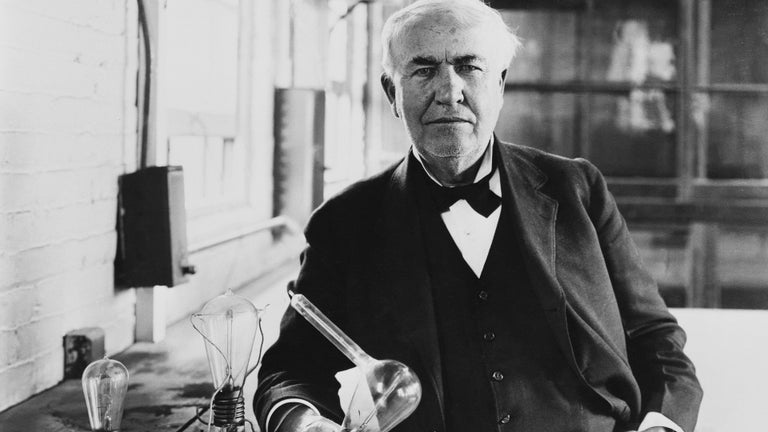
On February 19, 1878, Thomas Edison is awarded U.S. Patent No. 200,521 for his invention—the phonograph. The technology that made the modern music business possible came into existence in the New Jersey laboratory where Edison created the first device to both record sound and play it back.
Edison’s invention came about as spin-off from his ongoing work in telephony and telegraphy. In an effort to facilitate the repeated transmission of a single telegraph message, Edison devised a method for capturing a passage of Morse code as a sequence of indentations on a spool of paper. Reasoning that a similar feat could be accomplished for the telephone, Edison devised a system that transferred the vibrations of a diaphragm—i.e., sound—to an embossing point and then mechanically onto an impressionable medium—paraffin paper at first, and then a spinning, tin-foil wrapped cylinder as he refined his concept. Edison and his mechanic, John Kreusi, worked on the invention through the autumn of 1877 and quickly had a working model ready for demonstration.
The December 22, 1877, issue of Scientific American reported that “Mr. Thomas A. Edison recently came into this office, placed a little machine on our desk, turned a crank, and the machine inquired as to our health, asked how we liked the phonograph, informed us that it was very well, and bid us a cordial good night.”
The patent awarded to Edison on February 19, 1878, specified a particular method—embossing—for capturing sound on tin-foil-covered cylinders. The next critical improvement in recording technology came courtesy of Edison’s competitor in the race to develop the telephone, Alexander Graham Bell. His newly established Bell Labs developed a phonograph based on the engraving of a wax cylinder, a significant improvement that led directly to the successful commercialization of recorded music in the 1890s and lent a vocabulary to the recording business—e.g., “cutting” records and “spinning wax”—that has long outlived the technology on which it was based.
More news today
loading...